Let’s Talk, New York! A Sampling of Outstanding Conversations this month

Great Conversation is alive and well in NY.   Here’s a sampling from our  calendar of over 60 curated events offered by Conversations New York ( https://conversationsnewyork.com/calendar-of-conversations/ and http://www.meetup.com/Conversations-New-York/ ):

* Discuss outstanding books ranging from Lolita (1/15) to Dead Souls (1/14), to The Count of Monte Cristo (1/11).

* Celebrate MLK Day at BAM, and discuss the event afterwards with friends (1/19).

* Share your ideas and feelings about Love in a Socratic Conversation at Columbia University, as warm-up for Valentine’s Day (1/29).

* Meet interesting new people at brunch at the New York Ethical Society (1/18).

* Enjoy a Café Philo – the Parisian way of philosophical conversation (1/22).

* Experience the  Death Café, a popular approach to living more fully by confronting the reality of death (1/21).

1618434_587019884726367_1079857487_n

Holiday Greetings from Conversations New York (CNY)

CNY Montage

Dear CNY Friends, Colleagues, and Fellow Conversational Activists,

We wish you a joyous farewell to 2014, filled with loving, meaningful, astonishing conversations!

THANK YOU for your interest, support, and involvement which made this last 12 months immensely successful for all of us.

We have an even more exciting year planned for 2015, including city-wide conversations about LOVE around Valentine’s Day, our second annual CONVERSATIONS DAY in June, and possibly a second CONFERENCE at Columbia later in the year.

Hope to see you at our first gathering of 2015, at Columbia on Thursday, January 29th, for a Socratic Conversation at 4:00 followed by a CNY Meeting at 5:30.

Gratefully,
Ron  and Your CNY Team

Six Ways to Enhance Your Thanksgiving with Great Conversation!

As you look forward to bringing your family and friends together for the holidays, consider serving up some delectable conversation along with the victuals! Here are a half-dozen plus ways you can spice up your celebrations by adding a dash of provocative, entertaining, and illuminating talk.
What Do You Most Relish in Conversation?:
To start with, remind yourself of what you most relish in conversation. Recollect the most interesting conversation you had in the last week. (If you can’t think of one, get some new friends–fast!)
Ask yourself what made this conversation so enjoyable or valuable. When I ask this question, people usually say:
  • Sincerity/Caring
  • Wit or humor
  • Relevance
  • Charm
  • Originality
  • Clarity
  • Informativeness
Now think: which of the folks you’ll be having over are strong on one or another of these, and how can you give them a chance to express it? Who else might you invite who would bring delightful strengths to the conversation?
Holiday Thoughts:
Serve up some stimulating thoughts about the holidays themselves, easily available for a 30-minute Google search.
Try a Conversation Café:
Want to invite a few of your more thoughtful guests to go deeper? Try a “Conversation Café”, a simple but powerful way to enrich your sharing by passing around a “talking stick” (can be any object), which gives the person holding it the floor to express themselves fully on the topic of discussion. For the easy how-to, visit the Conversation Café.
Turn Your Party Into a Fascinating Salon:
Tap the riches in your circle by specifically asking two or three of your guests to tell the group about something exciting and interesting that they are passionate about: a civic project, a recent unusual journey, a newsworthy aspect of their profession.
Ask them in advance to be prepared to talk about it for 6 minutes, then hear others’ responses and questions. People need to be given permission to take the floor like this, but if they have something of real interest to talk about, others will welcome it. It turns your party into a fascinating Salon.
Really Listen to Your Guests:
Really listen to what your guests are saying when they touch on a subject of strong interest to them and to you, and make a point of asking for more. “Fred, that’s really interesting to me. Could you tell us more about how you learned that…how it works in practice…why you think it’s important…”
Avoid the “Organ Recital”:
Be on the qui vive to intervene when the talk gets turgid. Thoreau said, “We descend to meet.” Often there’s a tendency for people to head for the least common denominator in an effort not to seem pretentious. Nobody wants to be the one to offer a really stimulating, provocative, or informed thought. Some people even get mired in reciting their mutual aches and pains.  I call it the “organ recital.”
Consider it your responsibility as the host to move in at these points with a conversational pick-me-up. Your guests will bless you for it!
The Most Important Part of a Meal:
Conversation is your most readily-available, pervasive, and useful way to stimulate your mind and continue learning and growing. I was interviewed last week by a local talk-show host about how the right foods, exercise, etc. can keep our brains sharp. “What’s the most important part of a meal, for your mind?” the host asked.
My answer, “The conversation!”
Make that true at your table, too, and you’ll add a dimension to your holiday celebrations this year.


Conversations New York Meeting Notice – Nov 20

CONVERSATIONS NEW YORK 

www.conversationsnewyork.com 
You are warmly invited to the Monthly Meeting of CNY Members, Moderators, and Staff 
Thursday, Nov. 20, 5:30 – 7:00 pm 
(following the Socratic Conversation on “Wisdom” at 4:00 – 5:15 pm)
Teachers College, Columbia University
525 West 120th St., Gottesman Library, Room 104b
RSVP to grossassoc@aol.com and
http://www.meetup.com/Conversations-New-York/events/218168842/
Please bring photo ID required for entrance to building.

Please join us to celebrate CNY’s latest successes, including our upgraded website home-page (www.conversationsnewyork.com).

You’ll meet other CNY members, help plan for exciting new initiatives, receive new materials to enhance your conversations, and learn how to become a leader in this burgeoning movement!

“CNY is the most successful project I know of, to reclaim the peerless joys and infinite possibilities of life’s greatest, and most useful, pleasure!”, says Catherine Blyth, author of The Art of Conversation.

cny mtg

Conversations About Death: Halloween for Thinkers in New York

For more information:
Ronald Gross
Conversations New York
grossassoc@aol.com
 

CONVERSATIONS ABOUT DEATH:

HALLOWEEN FOR THINKERS IN NEW YORK

“Would It Kill You to Spend an Hour Talking About Death?”  

That’s the conversational challenge to New Yorkers in the period leading up to Halloween!

Conversations on the subject of Death will be hosted by organizations and institutions  including the New York Society for Ethical Culture, Trinity Church, and the Death Café of NY which has been featured on the front page of The New York Times.* 

In addition,  individuals and informal groups throughout the five boroughs are encouraged to organize their own conversations.   Easy-to-use instructions are available at www.deathcafe.com/how/ and www.TheConversationProject.org.

“These conversations will be celebrations of life,” says Ronald Gross, director of Conversations New York (CNY), the organization which is promoting the events.   “They are inspired by the classic dictum: ‘Do not fear death so much, but rather the inadequate life.’  (Bertolt Brecht)

Events will be listed on the CNY calendar at  http://www.conversationsnewyork.com starting October 5th.

Ninety percent of Americans think it’s important to have such conversations, according to a report issued by the Institute of Medicine earlier this month, but fewer than 30% actually have them.  

Gross will conduct a final event  at Columbia University on Thursday, Oct. 30th, the day before Halloween, at 4 pm, in 305 Russell Hall – to reserve a place, RSVP to grossassoc@aol.com.


Conversations New York (www.conversationsnewyork.com) is  a community of volunteers which organized a Conversation Day celebration in Bryant Park on August 30th,  in conjunction with similar events in San Francisco, London,  and  Paris, and earlier this year held a symposium on The Power of Conversation at Columbia University.

* Dates/times/locations (please check ahead to confirm that there’s been no change in scheduling):

Sunday, October 12,  1:30 pm – 4:00 pm, New York Society for Ethical Culture, 2 W. 64th St., Ceremonial Hall – 4th Floor, Moderator, Barbara Simpson.  A gathering in a relaxed and safe setting to discuss death, drink tea, and eat delicious cake. $5 suggested donation,   Also offered on Wednesday, October 22,  same time/place.  RSVP: bsmpson@gmail.com

Wednesday, October 15,  6 pm – 7:30 pm, Death Cafe meets  at Hunan Manor, 339 Lexington (bet. 39th and 40th Street, Hosted by Nancy Gershman and Audrey Pellicano.   

RSVP to http://www.meetup.com/Death-Cafe-New-York-City/events/146245342/ 

Price $11:00 per person includes endless pots of tea and small plates of savory foods, vegetable soup and fresh fruit.

Monday, Oct. 20, 6:30 – 8:30 pm, Trinity Church, 74 Trinity Place, 2nd Floor Parlor, Facilitated by Jane Gignoux.  Join us for an informal gathering where you can safely share with others your questions, concerns and/or experiences regarding any of the many aspects of death—our birthright.   There’s no intention of leading participants towards any particular conclusion, product or course of action. All are welcome.   RSVP: anehg@lifedeathbeyond.com

Thursday, October 30, 4 pm – 5:15 pm,  Teachers College, 525 West 120th St., Russell Hall Room 305, with Ronald Gross.

The Power of Conversation – Jul 24

Teachers College, 525 W. 120th St., Gottesman Library, Room 104b
RSVP to grossassoc@aol.com
and Meetup: http://www.meetup.com/Conversations-New-York/events/192621102/?a=co1.1_grp&rv=co1.1

This convening will consist of a Conversation at 4:00 – 5:15,
followed by a meeting of Conversations New York at 5:30 – 7:00.

COME FOR EITHER OR BOTH.

The Conversation – 4:00 – 5:15

“Look up, look at one another, and let’s start a conversation.” That is the powerful plea
of Prof. Sherry Turkle of MIT, author of the acclaimed Alone Together: Why We Expect More From Technology and Less From Each Other.  She urges us to transcend the digital gadgetry which has impelled us to “sacrifice conversation for mere connection….”

Let’s explore “Our Conversations, Ourselves” – the ways in which talking together can add even more to our joy in living – and strengthen our capacity to achieve common goals, in organizations or in our society.

Among the topics we’ll discuss:

** What’s one of the best conversations you’ve had in the last month?
What made it so good?

**  How satisfied  are  you with your conversations?  Do you
feel that more of them might be more like the BEST ones –
and wondered what makes the difference?

** Are there “design principles” for enhancing our conversations
for greater rapport, creativity, mutual understanding, and delight?

**  What’s your Conversational Style – and what do you feel are
its positive and negative consequences?  (Do such styles
typically differ between men and women, straight and gay,
or between different ethnic groups?)

** What role does conversation play in fostering participation
and engagement in a democratic society?   Is that role fulfilled
today in our communities?

** Where can you easily find enjoyable, illuminating
conversations in New York City – or create your own?

Meeting of CONVERSATIONS NEW YORK, 5:30 – 7:00

This session will share the findings of the Symposium on this topic held on July 10th, and welcome people interested in learning more about CNY’s vision and operations, and possibly joining to help enhance the quality of life in NYC through more and better conversations.

“Let’s Talk, New York!” — Invitational Symposium Fuels Great Conversations – Jul 10

THE POWER OF CONVERSATION

Report of Symposium held July 10, 2014 at Faculty House, Columbia University
Co-sponsored by Conversations New York

There is a robust revival of Conversation occurring today.   Face-to-face communication is being freshly understood, appreciated, championed, and enjoyed – as both a personal and a public good.  New kinds of conversations are addressing currently  compelling issues, employing  innovative facilitation techniques.  These small-group gatherings  are  enhancing  both personal fulfillment and democratic self-governance.  Conversation is re-emerging as a widespread, diverse, and effective way of enriching  our lives day-to-day, and of coping with our most divisive issues.

That is the overall theme which emerged from this Power of Conversation symposium on July 10, 2014.   The Symposium’s findings and conclusions follow.

We Need to Talk…As We Always Have

“Conversation is the iconic human activity. It’s who we are. Learning from each other – enjoying the sounds of our voices, yours and mine, exchanging thoughts and feelings, articulating, thinking beyond what we have in our own personal bank of resources. It is the main means by which we move forward together to create a future good for all.”

Sondra Myers, author of Democracy Is a Discussion:
Civic Engagement in Old and New Democracies

“Conversation is the most basic, most varied, and occasionally the most elevating of all human activities.  It is the way we convey information, inspire each other, and achieve understanding. Conversation is the way we challenge, amuse, and amaze each other.”
Jaida n’ha Sandra, The Joy of Conversation

Conversation has provided these joys and uses in virtually every era and culture.   It has enhanced the quality of life, nurtured relationships, and strengthened communities  — sometimes through sharp challenges to the status quo.   For example:

Native American tribes and other indigenous peoples traditionally have sat in a circle and talked together to deepen friendships and make collective decisions.

Socrates and his companions strolled the streets of 5th-century Athens, engaging in face-to-face conversations which laid the groundwork for the Western tradition of critical thinking.

Britains  turned the new coffee shops of 17th-century London into “Penny Universities” where constant conversation challenged conventional wisdom and official policy to such an extent that they were periodically shut down by the authorities.

Jewish women in 18th-century Europe, finding themselves doubly marginalized and excluded from cultural life, transformed their parlors, bedrooms, and attics into the salons which became hotbeds of philosophical, artistic, and cultural innovation.

Artists and intellectuals in the early 20th century in New York, Paris, and elsewhere, pioneered avant-garde thinking by convening in restaurants, bars, and people’s homes, as exemplified by the gatherings that anchored the Harlem Renaissance.

Mid-20th-century women throughout the world found each other by “Calling  the Circle,” discovered their own voices, and achieved greater fulfillment through the Feminist movement.

Protestors identifying themselves with the “99% of disenfranchised Americans” assembled in  Zuccotti Park in 2011 to launch the Occupy Movement, and put income inequality on the political agenda.

Towards a Renaissance of Conversation

This perennial tradition is being revived today. A renaissance of conversation is being eloquently championed by thought leaders, and passionately implemented by community-based enthusiasts – for both personal fulfillment and civic benefit.

“Look up, look at one another, and let’s start a conversation.” That is the powerful plea of Prof. Sherry Turkle of MIT, author of the acclaimed Alone Together: Why We Expect More From Technology and Less From Each Other. She urges us to transcend the digital gadgetry which has impelled us to “sacrifice conversation for mere connection….”

People are rediscovering the value of meeting face-to-face in small groups to discuss exhilarating and important subjects. They convene in coffee shops, bookstores, libraries, churches, community centers, parks. Projects like Conversation Cafes, Socrates Cafes, Café Philos, and even Death Cafes (to enhance living by talking candidly about death) are reviving the art of conversation. They are encouraging participants to pose challenging questions and consider different points of view, using a variety of simple but powerful guiding methodologies – or being boldly spontaneous.

The trend is not confined to the U.S. – Britain’s Financial Times reported recently that “public forums for the discussion of ideas are flourishing everywhere, from festivals to pubs.” One group in London has 2,000 members.

At the same time, conversation is emerging as essential to collaborative thinking and action. Organizations of all kinds, from non-profits to corporations to government agencies, are adopting innovative processes of conversation – most notably, the powerful technique called Dialogue — to address challenges more effectively.

Most promising in this public arena is a sharpening focus on the outcomes and benefits of these activities. Theorists and practitioners are asking: Does conversation lead to public decisions and actions, so that participants are encouraged by seeing tangible consequences of their participation?

Our Review of Projects, Programs, and Ideas

The Symposium explored the power of conversation in these two dimensions of our lives: personal fulfillment and collective achievement.

First, participants discussed initiatives to enhance our enjoyment of life, our health, and our happiness through three-minute presentations (“TED-3s”) on a number of outstanding projects and programs, including:

Café Philos,  HYPERLINK “http://www.nycafephilo.org/” http://www.nycafephilo.org/
From its origins in Paris 20 years ago, these grassroots forums for philosophical discussion have spread widely in Europe and the U.S., in cities ranging from NY, DC, and Boston, to Orlando, Denver, Atlanta, and Indianapolis.

Death Cafes,  HYPERLINK “http://www.deathcafe.com” http://www.deathcafe.com
The objective of Death Cafes is to increase awareness of death with a view to helping people make the most of their lives, by meeting socially, usually with food and drink, to share thoughts, feelings, and ideas.

Socrates Cafes,  HYPERLINK “http://www.philosopher.org/Socrates_Cafe.html” http://www.philosopher.org/Socrates_Cafe.html
Over 600 ongoing groups worldwide, inspired by the books and peripatetic activities of Christopher Philips, regularly bring people together to exchange ideas and experiences on the Socratic tradition.

The Family Dinner Project,  HYPERLINK “http://thefamilydinnerproject.org/” http://thefamilydinnerproject.org/
The Family Dinner Project helps families, schools, and community groups to engage in enjoyable, meaningful conversations while eating more quality meals together.

Conversation Cafes,  HYPERLINK “http://www.conversationcafe.org/” http://www.conversationcafe.org/
Open, hosted conversations in cafés as well as conference rooms and classrooms, using a simple process that helps to shift from small talk to big talk – conversations that matter.

Happiness Clubs,  HYPERLINK “http://www.happinessclub.com” http://www.happinessclub.com
A widespread network of conversation groups focused on happiness.

Socratic Conversations,  HYPERLINK “http://www.socratesway.com/join.html” http://www.socratesway.com/join.html
Monthly gatherings of students and faculty at Teachers College, Columbia University, to explore ideas and issues independent of academic structures.

Second, the Symposium reviewed and discussed the power of conversation to strengthen our capacity to achieve worthy goals in organizational, professional, and civic life. The presentations highlighted such projects and programs as:

The National Coalition for Dialogue & Deliberation,  HYPERLINK “http://www.ncdd.org” http://www.ncdd.org
NCDD is a network of thousands of professionals who bring people together to tackle challenging issues. The Coalition serves as an on-line gathering place, a resource clearinghouse, a news source, and a facilitative leader for this community of practice.

National Dialogue Network,  HYPERLINK “http://www.nationaldialoguenetwork.org/” http://www.nationaldialoguenetwork.org/
The NDN seeks to coordinate local conversations into mindful national dialogues. Its design and function is meant to strengthen local civic infrastructures.

Democracy Is a Discussion Handbooks,  HYPERLINK “http://www.sondramyers.org/books/democracy-is-a-discussion/” http://www.sondramyers.org/books/democracy-is-a-discussion/
This series of handbooks and related materials created by Sondra Myers are used throughout the world as a gateway to understanding democracy and the role that citizens play in making democracy work.

Interactivity Foundation,  HYPERLINK “http://www.interactivityfoundation.org” http://www.interactivityfoundation.org
The Foundation works to engage citizens in the exploration and development of possibilities for public policy through small group discussions.

Creating We Institute,  HYPERLINK “http://www.creatingwe.com/” http://www.creatingwe.com/
“Everything happens through conversations,” declares author Judith E. Glaser, who works with organizations to enhance their effectiveness. “To get to the next level of greatness depends on the quality of the culture, which depends on the quality of relationships, which depends on the quality of conversations.”

Conversations New York (CNY)

The Symposium also reviewed plans for Conversations New York ( HYPERLINK “http://www.conversationsnewyork.com” http://www.conversationsnewyork.com), a not-for-profit, volunteer initiative to enhance the quality of our lives and the healthfulness of our communities, through conversation.

LET’S TALK, NEW YORK! is the invitation extended by CNY for New Yorkers to come together in small groups of neighbors and fellow citizens to discuss topics that are enjoyable, interesting, and important, hosted at no cost and at convenient locations and times,  and inspired by simple guiding principles. Such conversations celebrate the city’s diversity, creativity, resourcefulness, friendliness, and civic vision.

A website has been launched ( HYPERLINK “http://www.conversationsnewyork.com” http://www.conversationsnewyork.com) with a monthly calendar of such conversations, which is already enabling over 500 followers and many more daily visitors to use the web to get off the web – to find or create opportunities to talk face-to-face.

CNY has two specific objectives: More Conversations, and Better Conversations.
More Conversations are promoted by “curating” from those already occurring throughout the city, and by initiating new ones.  Better Conversations are promoted by providing resources and consultation on best practices in designing, moderating, and evaluating conversations for continual improvement.

The goal is to have well over  100 public conversations occurring every day (two in each of the city’s 60 neighborhoods)  by January 1, 2015.

Bibliographical Note

Recent popular books (and some classics in the field) are inspiring and guiding people towards making better conversations part of their life and work.  There will be a comprehensive selection of these titles on display at the Symposium, thanks to Jennifer Govan and her associates at the Gottesman Libraries at Teachers College.

A Good Talk: The Story and Skill of Conversation, Daniel Menaker
Conversation: A History of a Declining Art, Stephen Miller
Conversation: How Talk Can Change Our Lives, Theodore Zeldin
Conversation—The Sacred Art: Practicing Presence in an Age of Distraction, D. Millis
Conversational Intelligence, Judith E. Glaser
Creating Conversations: Improvisation in Everyday Discourse, R. Keith Sawyer
Democracy is a Discussion Handbooks, Sondra Myers
Dialogue: Rediscover the Transforming Power of Conversation, L. Ellinor and G. Gerard
Dialogue and the Art of Thinking Together, William Isaacs
How Conversation Works, Ronald Wardhaugh
I and Thou, Martin Buber
On Dialogue, David Bohm
Socrates’ Way, Ronald Gross
The Art of Conversation, Catherine Blyth
The Magic of Dialogue: Transforming Conflict Into Cooperation, Daniel Yankelovich
The Tao of Conversation, Michael Kahn
Why Can’t We Talk? John Backman
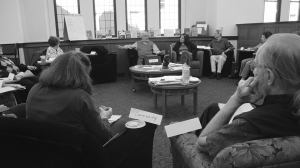


Home: Sharing Our Quests to Find or Create the Place We Need Most – May 29

Home: 

Sharing Our Quests to Find or Create the Place We Need Most
Thurs., May 29th, 4 – 5:15 pm

Socratic Conversation with Ron Gross
Gottesman Library, Teachers College, 525 West 120th St.
(#1 train to 116th St. — location between Broadway and Amsterdam Avenue)
(Coffee etc. can be purchased in cafe on ground floor)

RSVP to grossassoc@aol.com
and http://www.meetup.com/Conversations-New-York/events/183596732/

Photo ID required to enter building 


Please come to share your experiences, thoughts, feelings, and understanding:
  • What does Home mean to you? (Intimacy? Family? Style? Comfort? Well-Being? Security? Status? And/Or…?)
  • Your First Home – what was most important about it?
  • Where are you now in your quest for your true Home? (Seeking? Creating? Remembering? Questioning?)
  • Escape from Home: Do we need “Third Places” that are neither Home nor Work?
  • Homelessness as a Societal Scourge: Here in the Greater New York area, and among Displaced Persons Worldwide (“Send these, the homeless…to me.”)
  • “Home” as Metaphor: The concept of a national Homeland, Earth as Humanity’s “Home”

Optional Reading Suggestions:  Home: A Short History of an Idea; by Witold RybczynskiAt Home, by Bill Bryson; The Inspired Home: Nests of Creativity, by Kim Ficaro.

Where: 104b Russell Hall

Next conversation: Thursday, 7/24, Topic TBA

Inspired by Socrates’ famous conversations with his friends in the marketplace of 5th century Athens, we engage in spirited discussions of ideas and issues. Socratic conversations range broadly and probe deeply into the basic challenges of life. They are informed by the latest literature for reference and follow up. While building a sense of community, these meetings enliven the intellectual atmosphere and model dialogue and discussion as modes of inquiry. They are part of a year long series of Socratic Conversations hosted by the Gottesman Libraries.

These highly-participatory conversations are moderated by Ronald Gross, author of Socrates’ Way and Co-chair of the University Seminar on Innovation in Education.

You are warmly invited to share your thoughts, experiences, and thinking at these great conversations in April/May — on subjects ranging from Freud, and Ralph Nader, to Fantasy, the Dark Side of Comedians, Why We Love &; Why We Cheat, and Humanity’s Future.

You are warmly invited to share your thoughts, experiences, and thinking at these great conversations in April/May — on subjects ranging from Freud, and Ralph Nader, to Fantasy, the Dark Side of Comedians, Why We Love & Why We Cheat, and Humanity’s Future. 

These exciting, important conversations are just a sample of the dozens currently available on the calendar of Conversations New York, at  https://conversationsnewyork.com/calendar-of-conversations/

Please confirm the information below by checking the fuller listing on the Calendar.

IMPORTANT NOTE: Please read the complete information on any event  via the link on the CNY calendar – some events require RSVP or require pre-registration, or charge a nominal fee; and occasionally event organizers change event dates or cancelled.


DATE/TIME: Wed., April 23, 6:30 pm

TOPIC: Freud’s BEYOND THE PLEASURE PRINCIPLE

CONVENOR: Perennial and Hermetic Philosophies Study Group

LOCATION: Panera Bread Café (38-01 35th Avenue (off Steinway street), Astoria, Queens 11101, NY 11101)

RSVP athttp://www.meetup.com/Perennial-and-esoteric-philosophy-study-group-of-NYC/events/168452262/


DATE/TIME: Thurs., April 24, 7-9 pm

TOPIC: WHAT DO YOU SEE AS HUMANITY’S FUTURE – MORALLY, POLITICALLY, SOCIALLY, PHYSICALLY?

CONVENOR: NYC Socrates Cafe

LOCATION: Bread & Butter (419 Park Ave S # A, New York, NY 10016)

RSVP at  http://www.meetup.com/NYCSocratesCafe/events/174144002/


DATE/TIME: Sun., April 27, 2-5 pm

TOPIC: ALIF THE UNSEEN by G. Willow Wilson

CONVENOR:  NY SciFi & Fantasy Club

LOCATION:  Must join group and RSVP to obtain meeting location.   ​http://www.meetup.com/NYSciFi-Fantasy/events/174419212/


DATE/TIME: Tues., April 29, 5:30-6:3)0 pm

TOPIC:  THE DARK SIDE OF BEING A GOOD COMEDIAN

CONVENOR: St. Agnes Library Article Discussion Group

LOCATION: St. Agnes Library (Amsterdam Ave. – see listing on Calendar for address and map)


DATE: Thurs.,  May 1, 4:30-6:30 pm

TOPIC:  INTERNATIONAL WOMEN’S WRITING GUILD DISCUSSION GROUP

CONVENOR: Hannelore Hahn

LOCATION:  NY Public Library, 67th Street Library, East 67th Street (see Calendar listing for address and map)


DATE: Tues., May 6, 6:30-9:00

TOPIC: WHY WE LOVE, WHY WE CHEAT, by Helen Fisher

CONVENOR: Club Ted

LOCATION: 49 Grove  (btw Christopher St and 7th Ave)

RSVP at http://www.meetup.com/ClubTED/events/176471792/

What’s YOUR “Triple Package”? Discovering and Activating Your “Signature Strengths” – Mar 27

What’s YOUR “Triple Package”?
    Discovering and Activating
   Your“Signature Strengths”

with Ron Gross, Thursday, 3/27, 4 sharp – 5:15pm

Gottesman Library, Teachers College, Columbia University

   525 West 120th St.  

(bet. Broadway and Amsterdam Ave.  North side of 120th Street — #1 train to 116th St.)

Please bring a photo ID required for entry to the building.

There will be a display of relevant books.
                        Light refreshments will be available.
Coffee and other beverages available downstairs as you enter the building.


Each of us has a constellation of strengths deriving from our personal qualities, cultural background, and life experiences.   In this session you  will  identify three of yours, share them, and contribute  them to  a ‘Gang Brain’ representing the collective strengths of the group.
    
The session is inspired by the best-selling and highly controversial  book The Triple Package: How Three Unlikely Traits Explain the Rise and Fall of Cultural Groups in America, by Amy Chua and Jed Rubenfeld, both professors at Yale Law School.  The book and the authors have been featured prominently in several major articles in the New York Times and in myriad other media.  We will discuss their thesis as background to our own work with this concept.
 
    Next conversation: Thursday, 4/17, Topic to Be Announced.